
Transit Data Dashboard
Explore the Dashboard
See where transit and mobility in Greenville stand today on the General Access page: Who has access to transit and how is it utilized? How about people biking, driving, or walking? See the whole story of transportation in all of Greenville County, or see how neighborhoods differ.
Explore how expanding our transit system’s footprint can open the door to new jobs, essential services, and opportunities on the Future Opportunities tab. Lots of people and businesses aren’t served by transit. See how we can fill those gaps.
From healthcare, the grocery store, and everywhere in between, transit infrastructure gets people where they need to go. Explore the Access to Essential Services tab to see how many essential services can be reached with transit, and where transit can improve its reach.
Take the budget into your own hands on the Roads or Transit tab. It costs around one million dollars to pave just one mile of road. What could transit do with more funding?
We built our data dashboard with the help of the Shi Institute for Sustainable Communities at Furman University. It’s their hard work and expertise that allow us to tell the story of mobility in Greenville and make the case for a stronger, more connected community.
Why Transit?
Transit is an essential part of our infrastructure that keeps our community moving. That’s right. Infrastructure. Just like roads and bridges, a reliable transit network keeps our city and county thriving by opening the door to all of the opportunities Greenville’s growth provides.
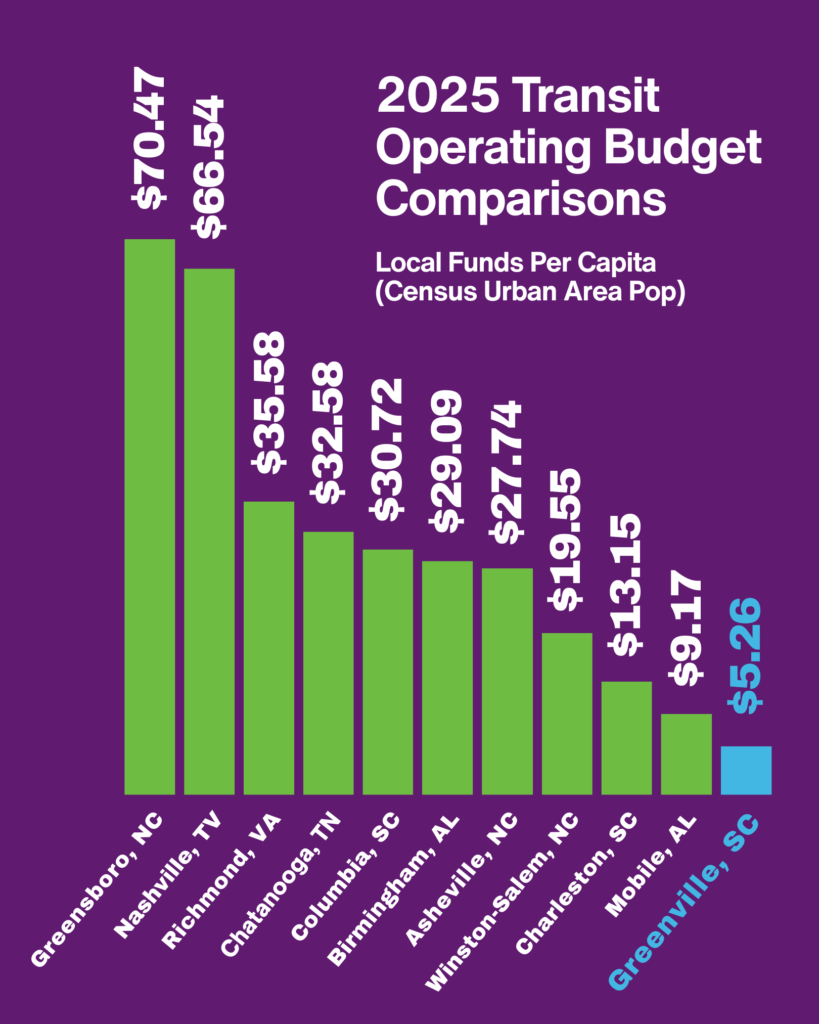
Greenville is growing quickly. The county has added over 100,000 people since 2010, and an additional 200,000 are expected by 2040. 15-minute commutes have turned to 30, and they’ll soon be 45 if we don’t adapt. An expansive and reliable transit system can reduce the number of cars on the road, shorten commute times, and increase safety. If time is money, transit is well worth the investment.
Compared to peer cities like Columbia, Chattanooga, and Birmingham, Greenville invests the least per capita in its transit system. If we don’t catch up, we could be leaving millions of dollars of economic growth on the table.
In our commissioned study by research economists at the University of South Carolina, we found that per each dollar invested in transit, between $80 and $30 are returned in economic activity.